


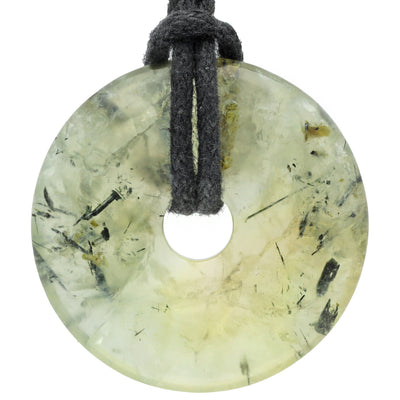
Prehnite shimmers pale apple green to yellow-green, milky-translucent and with a typically botryoidal surface. In crystal healing, it is the “stone of unconditional trust” — known for letting go, clearing out, and bringing peace to the heart. In this guide, you’ll find everything about the attributed effects of Prehnite, its meaning, uses, and proper care — compiled by a specialist retailer.
Prehnite — quick facts at a glance
| Mineral class | Silicate — calcium aluminum silicate |
| Color | pale yellow-green to apple green, milky translucent |
| Hardness (Mohs) | 6 to 6.5 |
| Crystal system | orthorhombic — usually botryoidal/nodular |
| Chakra | Heart chakra (Anahata) |
| Zodiac sign | Libra (main), Virgo, Pisces |
| Element | Earth / Water |
| Special feature | first mineral to be named after a person |
| Suitable for gemstone water | Yes — do not leave in water permanently |
| Sunlight | Avoid prolonged direct sunlight |
| Main sources | South Africa, Australia, Mali, China |
What is Prehnite? Mineralogy and origin
Prehnite is a calcium aluminum silicate with a Mohs hardness of 6 to 6.5 — moderately robust, so suitable for everyday use, but not indestructible. Its typical feature is its botryoidal to nodular growth form: it does not form pointed crystals, but rounded shapes like fused-together spheres.
Its color ranges from pale yellow-green through apple green to mint green, and it is milky translucent with a soft, waxy-pearly sheen. It is often crossed by fine black needles of epidote — a popular collector’s piece and a good authenticity marker.
Prehnite is the first mineral ever named after a person: after the Dutch colonel Hendrik von Prehn, who brought it from the Cape of Good Hope to Europe in 1774. Important sources include South Africa, Australia, Mali, and China.
Meaning & history
Since its first description in 1788, Prehnite has been regarded as a milestone in mineralogy — with it began the tradition of naming minerals after their discoverers.
In tradition, Prehnite is described as the “stone of prophecy” — it was believed to sharpen intuition and open the view toward the future.
In modern crystal healing, it is above all the stone of unconditional trust: it is said to help release control, let go of the old, and bring order back to the inner self.
Attributed effect of Prehnite on the psyche
When someone says to us, “I just can’t let go” — when tidying up, when closing a chapter, when trusting — Prehnite is our typical recommendation. In crystal healing, it is said to have the following effects:
- Trust & confidence: The classic — Prehnite is considered a stone of unconditional trust in life and in oneself.
- Letting go: Said to help avoid clinging to the old — both emotionally and very practically when decluttering.
- Order & structure: Associated with clear priorities and a tidy mind.
- Peace of heart: Said to calm the heart when worries and rumination become overwhelming.
- Intuition: Traditionally described as a stone that strengthens gut feeling and makes decisions easier.
- New beginnings: Often used as a companion stone after farewells and during transitional phases.
Prehnite is therefore especially suitable for phases in which letting go, clearing out, trust, or a fresh start are the focus — and for people who want to control everything and find it hard to delegate or release.
Attributed effect of Prehnite on the body
In traditional crystal healing, the following physical effects are attributed to Prehnite — these statements come from traditional descriptions and are not a substitute for medical diagnosis or treatment.
- Kidneys & bladder: Traditionally assigned in folk healing to the detoxifying area.
- Connective tissue: Traditionally associated with firm, elastic connective tissue.
- Metabolism: Mentioned in old descriptions as an invigorating, clarifying stone.
- Nerves & tension: Said to have a calming effect on inner restlessness and worries.
- Sleep: Traditionally used for restful sleep when thoughts keep circling.
- Well-being: Considered a gentle, organizing companion in everyday life.
With a hardness of 6–6.5, Prehnite is suitable for gemstone water — use lukewarm, clear water and ideally do not leave it immersed permanently. In crystal healing, the water is considered clarifying and calming. Suitable tumbled stones can be found in our Prehnite range.

Prehnite and the chakras
In chakra teachings, Prehnite is assigned to the heart chakra (Anahata) — the center of love, trust, and compassion. Its pale green is the classic heart chakra color.
Unlike the warm rose quartz, Prehnite is considered the clarifying, clearing heart stone: it is said not only to comfort, but also to remove emotional burdens from the heart — old wounds, held-on-to worries, excessive control.
In practice, Prehnite is placed on the heart or worn as a pendant — often consciously during phases when one wants to close a chapter.
Prehnite & the 7 main chakras
Prehnite is a clarifying heart chakra stone — it is said to give trust, help with letting go, and bring peace to the heart.
Prehnite and the zodiac signs
Astrologically, Prehnite is considered the main stone for Libra — this weighing air sign is said to benefit from it when making decisions and then letting go.
As a secondary stone, it also suits Virgo (order without perfection pressure) and Pisces (trust, intuition). As a stone of trust, however, Prehnite suits anyone who wants to let go and create order again.
Using Prehnite in everyday life
1. While decluttering — the clearing stone
Put Prehnite in your pocket when it’s time for the basement, closet, or paperwork. It is said to make letting go easier — probably the most popular use.
2. As a pendant — trust close to the heart
A Prehnite pendant worn at heart level is said to remind you of confidence when control feels difficult.
3. In meditation — releasing burdens
Place the stone on the heart and exhale consciously. It is said to create inner space.
4. During farewells — as a companion stone
Traditionally used during moves, job changes, or separations to help close the chapter on the old.
5. On the desk — for clear priorities
A tumbled stone in view is said to help you focus on what matters most.
Prehnite bei Lebensquelle Plus
Echte Naturqualität — versandfertig aus Waldbröl, geprüfter Fachhandel.

![[slot:MAIN] MAIN polished](http://lebensquelle-plus.de/cdn/shop/files/SQUARE_new_4f3b2b4e-bcdf-454a-9caf-90d5e510f805.jpg?v=1787043078&width=400)
![[slot:MAIN] MAIN polished](http://lebensquelle-plus.de/cdn/shop/files/SQUARE_new_5212f521-0132-4eb2-9d9e-3e0a16d1cfba.jpg?v=1787560005&width=400)
Clean and recharge Prehnite
Clean & recharge Prehnite
Prehnite is moderately robust with hardness 6–6.5 — uncomplicated, but not for prolonged sun exposure.
Discharge
Rinse under lukewarm, running water and dry it. No chemical cleaners.
Alternatively, discharge overnight in a bowl with hematite tumbled stones.
Recharge
Recharge in moonlight or on a clear quartz cluster or amethyst geode.
A clear quartz cluster is the gentlest long-term solution — completely without sun stress.
⚠️ Avoid prolonged direct sunlight. Protect from hard impacts and do not use chemical cleaners or ultrasonic devices.
Recognizing authenticity
Prehnite is often confused with jade, serpentine, green fluorite, and glass. These features help:
- Botryoidal surface: Unworked Prehnite shows the typical botryoidal (“grape-like”) form of fused spheres — a very reliable identifying feature.
- Milky sheen: Genuine Prehnite is translucent with a soft, waxy-pearly luster — not glass-clear and not completely opaque.
- Epidote needles: Fine black to dark green needles inside point to genuine Prehnite — an imitation does not have this.
- Hardness: Prehnite scratches glass with 6–6.5. Green fluorite (hardness 4), by contrast, does not — that is the simplest test.
- Hue: Typically a pale yellow-green to apple green. Saturated emerald or bottle green suggests dyed material or another stone.
Genuine Prehnite is pale yellow-green, milky translucent, often botryoidal, and scratches glass. At Lebensquelle Plus, we focus on natural quality.
Combining Prehnite with other stones
- Prehnite + Rose Quartz — peace of heart in a double pack — Prehnite clears out, Rose Quartz comforts.
- Prehnite + Clear Quartz — Clear Quartz clarifies and amplifies the organizing effect.
- Prehnite + Amethyst — letting go meets inner peace — popular during phases of rumination.
- Prehnite + Smoky Quartz — release burdens and ground yourself — the combination for transitional times.
- Prehnite + Aventurine — a gentle heart combination for serenity and confidence.
Frequently asked questions about the effect of Prehnite
01 What does Prehnite do? +
In crystal healing, Prehnite is considered the stone of unconditional trust. It is said to help with letting go, promote order and clear priorities, and bring peace to the heart. As a heart chakra stone, it is especially used during transitional phases and when decluttering.
02 Why is Prehnite called Prehnite? +
After the Dutch colonel Hendrik von Prehn, who brought the mineral from the Cape of Good Hope to Europe in 1774. Prehnite is thus the first mineral ever named after a person — before that, names were purely descriptive.
03 What is the difference between Prehnite and Jade? +
Prehnite is paler and milky translucent with a waxy sheen and typically grows botryoidally. Jade is usually a richer green, fine-fibrous, and much tougher. Another clue for Prehnite is fine black epidote needles inside, which Jade does not have.
04 Can Prehnite go in water? +
Yes. With hardness 6–6.5, Prehnite is moderately robust — rinsing under lukewarm running water for cleaning is unproblematic, and it is suitable for gemstone water. It’s best to use clear water and not leave the stone immersed permanently.
05 How do I care for Prehnite properly? +
Rinse under lukewarm running water and dry it. Recharge in moonlight or on a clear quartz cluster or amethyst geode. Avoid prolonged direct sunlight, no chemical cleaners, no ultrasonic devices. Full guide: Clean and recharge gemstones.
06 Is Prehnite the stone for decluttering? +
In crystal healing, yes — that is its best-known use. Prehnite is traditionally put in a pocket when the basement, wardrobe, or filing pile needs attention. It is said to make letting go easier and help set clear priorities.
07 Which zodiac sign is Prehnite for? +
Prehnite is primarily assigned to Libra, which it is said to help with decision-making and letting go. As a secondary stone, it suits Virgo and Pisces. As a stone of trust, however, it suits anyone who wants to release control and create order.
08 Which stones go well with Prehnite? +
Classic combinations: Prehnite + Rose Quartz (peace of heart), Prehnite + Smoky Quartz (release burdens and ground), Prehnite + Amethyst (letting go and calm), Prehnite + Clear Quartz (amplification), Prehnite + Aventurine (serenity).
Conclusion
Prehnite — the stone of unconditional trust. In crystal healing, the classic for letting go, clearing out, and bringing peace to the heart. Anyone who wants to control everything, struggles to close a chapter, or is currently in a transitional phase will find a very friendly companion in it — and with hardness 6–6.5, it is well suited for everyday use.
In our Prehnite range ↗, you’ll find tumbled stones, pendants, donuts, and bracelets made from genuine natural quality — ready to ship from Waldbröl or directly on site in our store in Nümbrecht.
Important note: The effects described here come from traditional crystal healing and are not scientifically proven. They do not replace medical diagnosis or treatment. If you have health concerns, please consult a doctor.
Further gemstone guides
- Clear Quartz effect — meaning, use & cleansing
- Amethyst effect — meaning, use & cleansing
- Clean and recharge gemstones — the easy way
- Aventurine effect — serenity & heart
- Smoky Quartz effect — grounding & letting go
- View all Prehnite products
