



Magnesite is the calm, chalk-white stone with the fine gray veining — inconspicuous at first glance, but a classic in crystal healing. It is said to release tension, promote composure, and bring inner stillness. In this guide, you’ll find everything about the attributed effects of Magnesite, its meaning, uses, and proper care (it is soft and does not like acids!) — compiled by a specialist retailer.
Magnesite — quick facts at a glance
| Mineral class | Carbonate — magnesium carbonate (MgCO₃) |
| Color | chalk white to creamy white, with gray to brownish veins |
| Hardness (Mohs) | 3.5 to 4.5 — soft |
| Crystal system | trigonal — usually massive/nodular |
| Chakra | Crown chakra (Sahasrara) |
| Zodiac sign | Aries (main), Taurus, Cancer |
| Element | Earth |
| Special feature | often confused with Howlite — same appearance in trade |
| Suitable for gemstone water | Yes — clear, still water, do not leave in permanently |
| Sunlight | Tolerates sun |
| Main sources | Brazil, China, Austria (Styria), Greece |
What is Magnesite? Mineralogy and origin
Magnesite is a magnesium carbonate (MgCO₃) from the carbonate class — chemically, a close relative of calcite, only with magnesium instead of calcium. With a Mohs hardness of 3.5 to 4.5, it is one of the soft stones and should be protected from scratches and impacts.
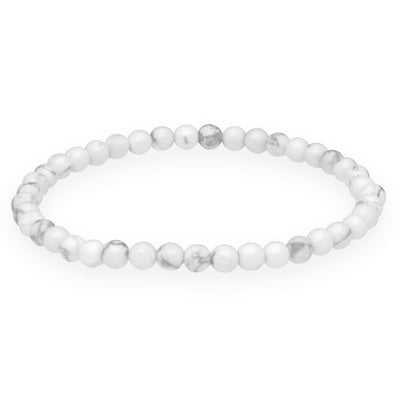
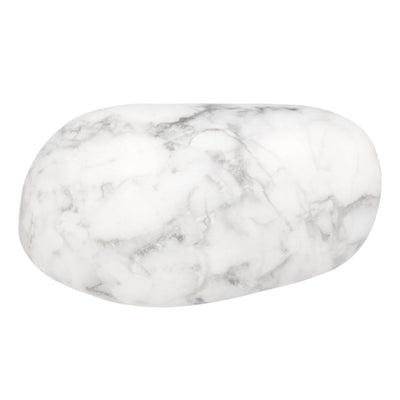
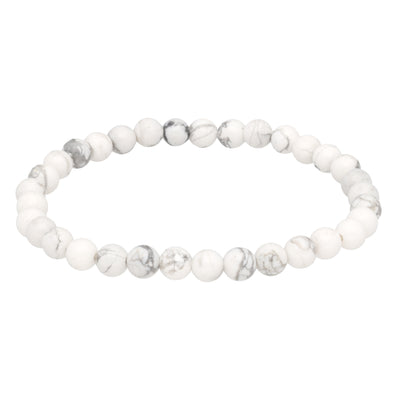
Typical is its chalk-white, almost porcelain-like appearance with a fine network of gray to brownish veins. This exact pattern leads to the most common confusion: in trade, Magnesite is often labeled as Howlite and vice versa — both look strikingly similar. At Lebensquelle Plus, we consistently list these stones as Magnesite.
Important for care: as a carbonate, Magnesite reacts with acids — lemon, vinegar, or acidic cleaners attack the surface and make it dull and rough. Main sources are Brazil, China, Austria (Styria), and Greece.
Meaning & history
Magnesite takes its name from the Greek region of Magnesia in Thessaly — the same root from which “magnet” and “magnesium” are derived.
Technically, Magnesite was long primarily an industrial mineral: to this day it is the most important raw material for refractory linings in blast furnaces and provides magnesium for many applications.
In modern crystal healing, Magnesite is the stone of relaxation — a quiet, balancing companion for anyone who finds it hard to switch off. Its white, calm appearance fits this attribution perfectly.
Attributed effect of Magnesite on the psyche
When someone asks us for a stone to wind down — during constant stress, racing thoughts, or inner restlessness — we quickly think of Magnesite. In crystal healing, the following effects are attributed to it:
- Relaxation & letting go: The classic — Magnesite is said to release inner tension and help you switch off.
- Composure & patience: Said to help you respond more calmly to stimuli and lengthen your fuse.
- Inner stillness: Used when thoughts keep circling and the mind won’t settle.
- Self-love & acceptance: Considered a gentle stone that is said to encourage a kinder approach to oneself.
- Balance: Said to cushion emotional swings and create a calm baseline feeling.
- Meditation & mindfulness: Traditionally a popular companion stone for quiet practices and meditation.
Magnesite is therefore especially suitable for phases in which stress, sensory overload, rumination, or impatience are an issue — and for people who struggle to switch off or who quickly get worked up.
Attributed effect of Magnesite on the body
In traditional crystal healing, the following physical effects are attributed to Magnesite — these statements come from traditional descriptions and are not a substitute for medical diagnosis or treatment.
- Muscles & tension: Traditionally associated in folk healing with loosened, relaxed muscles.
- Cramps: Traditionally assigned to the cramp-relieving area — fitting the association with magnesium.
- Nerves & tension: Described as a calming, nerve-strengthening stone.
- Sleep & rest: Traditionally used for falling asleep and staying asleep peacefully.
- Head & forehead: Mentioned in old descriptions for stress-related tension in the head area.
- Well-being: Considered a gentle, relaxing companion in everyday life.
Magnesite is suitable as a water stone — best with clear, still water. Because it is soft with a hardness of 3.5–4.5 and reacts to acids as a carbonate, the rule is: do not leave it in water permanently, dry it afterward, and do not use acidic additives (lemon!). In crystal healing, the water is considered relaxing and soothing. Suitable rough stones can be found in our Magnesite range.

Magnesite and the chakras
In chakra teaching, Magnesite is primarily assigned to the crown chakra (Sahasrara) — the energy center at the crown of the head, which stands for stillness, clarity, and connection to the higher realm. Its pure white color suits this luminous chakra.
As a crown chakra stone, Magnesite is said to clear the mind, stop the carousel of thoughts, and create a calm, spacious inner state — exactly what many people seek in meditation.
In practice, Magnesite is placed on the forehead or above the head, held in the hand, or worn as a bracelet to bring calm into everyday life.
Magnesite & the 7 main chakras
Magnesite is a quiet crown chakra stone — it is said to calm thoughts, relax, and create inner spaciousness.
Magnesite and the zodiac signs
Astrologically, Magnesite is considered the main stone for Aries — the impulsive fire sign, which it is said to grant calm, patience, and greater endurance.
As a secondary stone, it also suits Taurus (composure, enjoyment) and Cancer (emotional balance). As a stone of relaxation, however, Magnesite suits anyone seeking less tension and more inner peace.
Using Magnesite in everyday life
1. As a bracelet — relaxation all day long
A Magnesite bracelet on the wrist is said to provide continuous calming — popular on stressful workdays. Because of its low hardness, it’s better to remove it during sports or cleaning.
2. In meditation — for inner stillness
Hold Magnesite in your hand or place it on your forehead. It is said to slow down racing thoughts and deepen the practice.
3. On the bedside table — to come to rest
A tumble stone next to the bed is traditionally used for peaceful falling asleep and staying asleep.
4. In your pocket — the anti-stress stone
As a pocket stone: take it in your hand briefly and breathe deeply when things get hectic.
5. In the work area — against sensory overload
A Magnesite on the desk is said to create a calmer, more composed working atmosphere.
Magnesite bei Lebensquelle Plus
Echte Naturqualität — versandfertig aus Waldbröl, geprüfter Fachhandel.

Cleaning and charging Magnesite
Clean & charge Magnesite
Magnesite is soft with a hardness of 3.5–4.5 and sensitive to acids — it needs gentle care.
Discharge
Only briefly rinse under lukewarm running water and then dry thoroughly. No acids (lemon, vinegar) and no chemical cleaners — Magnesite reacts to them!
Alternatively, discharge overnight in a bowl with hematite tumble stones — completely without water.
Charge
Charge in moonlight or on a rock crystal cluster or amethyst geode.
A rock crystal cluster keeps Magnesite fresh long-term — without water, without sun heat.
⚠️ Soft (3.5–4.5): protect from scratches and impacts, do not store together with hard stones. No acids, no ultrasonic cleaners. As a water stone, do not leave in water permanently.
Recognizing authenticity
Magnesite is probably the most frequently dyed stone in trade — sold as supposed “turquoise” or “lapis lazuli.” These features help:
- Recognizing dyed material: bright turquoise or deep blue “Magnesite” stones are dyed. The color then sits mainly in the veins and cracks and looks too uniform and vivid. Genuine Magnesite is white to creamy white.
- The turquoise trick: dyed Magnesite (trade name also “Turkenite”) is often sold as turquoise. Genuine turquoise is more expensive and shows a finer, more irregular matrix.
- Hardness: Magnesite is soft at 3.5–4.5 — it can be scratched with a knife tip. A “Magnesite” that scratches glass is not one.
- Veining: typical is a fine, irregular gray to brownish network pattern — not a uniform pattern like plastic imitations.
- Feel: genuine Magnesite feels cool and stony and is matte to silky; plastic imitations feel warm and light.
Genuine Magnesite is white to creamy white, soft, and finely gray-veined. At Lebensquelle Plus, we carry it in natural, undyed quality.
Combining Magnesite with other stones
- Magnesite + Amethyst — the calm duo — Amethyst clears the mind, Magnesite relaxes the body.
- Magnesite + Rose Quartz — a gentle combination for self-love, heart calm, and security.
- Magnesite + Rock Crystal — Rock Crystal clarifies and amplifies the calming effect.
- Magnesite + Lepidolite — double relaxation — the classic for stressful phases.
- Magnesite + Black Tourmaline — calm meets grounding — popular for sensory overload.
Frequently asked questions about the effect of Magnesite
01 What does Magnesite do? +
In crystal healing, Magnesite is considered a stone of relaxation and inner peace. It is said to release tension, make you more composed and patient, and slow down racing thoughts. As a crown chakra stone, it is often used for meditation and during stressful phases.
02 Is Magnesite the same as Howlite? +
In trade, both names are used for the same material — a white stone with fine gray veining. Mineralogically they are two different minerals (Magnesite is a magnesium carbonate, Howlite a borate), but visually they are almost indistinguishable. At Lebensquelle Plus, we consistently list these stones as Magnesite.
03 Can Magnesite go in water? +
Yes, Magnesite is suitable as a water stone — best with clear, still water. Because it is soft with a hardness of 3.5–4.5 and reacts to acids as a carbonate, it should not be left in water permanently and should be dried afterward. Acidic additives like lemon are taboo.
04 How do I care for Magnesite properly? +
Briefly rinse under lukewarm water, dry thoroughly. Charge in moonlight or on a rock crystal cluster. Avoid: acids (lemon, vinegar), chemical cleaners, ultrasound, hard impacts, and scratches — the stone is soft. Full guide: Clean and charge gemstones.
05 Is blue or turquoise Magnesite real? +
The stone itself is real, the color is not. White Magnesite can be dyed very well because of its porosity and is then sold as a turquoise or lapis imitation. Genuine Magnesite is white to creamy white with gray veins. We carry it undyed in natural quality.
06 Which zodiac sign is Magnesite for? +
Magnesite is mainly assigned to Aries, which it is said to grant calm and patience. As a secondary stone, it suits Taurus and Cancer. As a stone of relaxation, however, it suits anyone seeking more composure.
07 Which stones go well with Magnesite? +
Classic combinations: Magnesite + Amethyst (calm for mind and body), Magnesite + Lepidolite (double relaxation), Magnesite + Rose Quartz (self-love), Magnesite + Rock Crystal (amplification), Magnesite + Black Tourmaline (calm and grounding).
08 Is Magnesite suitable as a gift? +
Very much so — Magnesite is a simple, friendly gift for anyone who has a lot on their plate and could use more calm. As a bracelet, tumble stone, or pendant, it stands for relaxation and composure.
Conclusion
Magnesite — the quiet relaxer. In crystal healing, the classic for composure, letting go, and inner peace. If you find it hard to switch off, get irritated quickly, or are looking for a calm companion stone for meditation and sleep, Magnesite is the right choice — it just needs a little care because it is soft.
In our Magnesite range ↗ you’ll find bracelets, tumble stones, and pendants made from genuine, undyed natural quality — ready to ship from Waldbröl or directly on site in our store in Nümbrecht.
Important note: The effects described here come from traditional crystal healing and are not scientifically proven. They do not replace medical diagnosis or treatment. If you have health concerns, please consult a doctor.
Further gemstone guides
- Rock Crystal effect — meaning, use & cleansing
- Amethyst effect — meaning, use & cleansing
- Clean and charge gemstones — the easy way
- Lepidolite effect — the relaxation stone
- Amethyst effect — calm & clarity
- View all Magnesite products
